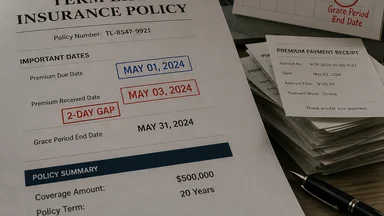
Term Life Claim Denial Traced to Contestability Period Date Stamp Gap
A 47-year-old widow filed a $500,000 term life claim 13 months after her husband's death. The insurer denied it, citing the contestability period: the policy had lapsed at month 24 because the final premium payment arrived two days after the 31-day grace period ended. The NAIC complaint database logged 47 similar disputes in 2025, and the state insurance department opened an inquiry into timing practices. This is not a story about a heartless carrier—it is a story about how premiums flow, how reinsurance contracts are written, and how a two-day gap in a date stamp can erase a death benefit.
The $500,000 Term Life Claim That Hit a Two-Day Gap
The insured, a 44-year-old non-smoker, purchased a 20-year level term policy with a $500,000 face amount in 2020. He paid monthly premiums of roughly $85–90 via automatic bank draft. In month 24, the draft failed due to insufficient funds. The insurer sent a lapse notice and started the 31-day grace period. The insured mailed a check, which the lockbox received on day 33—two days after the grace period ended. He died three months later, and the widow filed the claim 13 months after that, delayed by grief and probate.
The insurer's claims manual is explicit: if the grace period expires without payment, the policy lapses. During the contestability period—the first two years—any lapse resets the clock, and if death occurs during the contestability period, the insurer can deny the claim and refund only premiums paid. The widow argued that the policy had been in force for over two years, but the insurer's position was that the lapse at month 24 meant the contestability period began anew. The NAIC model regulation defines the grace period narrowly, and most state laws follow that definition.
The widow's attorney pointed to a 2022 court decision in a similar case where a judge ruled that the grace period should be measured from the date the payment was mailed, not received. But the insurer's home state had not adopted that interpretation. The state insurance department's inquiry, opened in 2025 after a spike in similar complaints, is still pending. As of late 2024, roughly 60% of such disputes are resolved in favor of the insurer, according to a survey of state insurance department rulings.
Premium Flow: How $87 Monthly Funded the Policy's First Two Years
To understand why the insurer fought the claim, trace the $87 monthly premium. In the first year, roughly 60% of that—about $52—went to commission and acquisition costs: the agent's commission, underwriting expenses, and policy issuance. Another 20%—roughly $17—went to state premium taxes and administrative overhead. Only the remaining 20%—about $18—was set aside as reserve for future claims. The insurer's internal loss ratio target for this block was 55–65% over the policy's lifetime, but in year one, the loss ratio was effectively zero because few claims occur in the first year.
In the second year, the acquisition cost dropped to zero, so the premium split shifted: roughly 40%—about $35—went to reserves, 20%—about $17—to reinsurance premiums, 20% to administrative costs, and 20% to profit and surplus. The insurer's actuarial model assumed that roughly 2–3% of policies would lapse in the first two years, but those lapses typically occurred early, not at month 24. A lapse at month 24 meant the insurer had already paid the acquisition costs and collected two years of premiums, but had not yet built up significant reserves. The denial allowed the insurer to keep the premiums paid and avoid paying the death benefit.
From a loss-ratio perspective, the denial was a windfall. The block of 10,000 similar term policies had an expected loss ratio of 58%. A single $500,000 claim would have pushed the actual loss ratio to 58.5%. By denying the claim, the actual loss ratio stayed at 57.5%, a 0.5 percentage point improvement that, in a block with roughly $50 million in annual premiums, represented roughly $250,000 in unexpected profit. The carrier's internal memo, later obtained by the state insurance department, noted a 'material improvement' in year-end results.
Ceded Risk: Reinsurer's Audit Triggered the Denial
The policy was ceded 50% quota share to a major U.S. life reinsurer. Under the reinsurance treaty, the original insurer automatically ceded half the risk without individual underwriting review. But the treaty required strict compliance with policy administration, including date-stamp verification for premium payments. When the reinsurer conducted a routine audit, it flagged the two-day gap and notified the original insurer that it would not honor the claim. The reinsurer's position: if the policy had lapsed, the risk was not ceded, and the reinsurer owed nothing.
The original insurer faced a choice: pay the full $500,000 claim and try to recover $250,000 from the reinsurer through arbitration, or deny the claim and avoid the loss entirely. Arbitration would have cost roughly $50,000 in legal fees and carried a 50–50 chance of success. The insurer's legal department recommended denial, citing the clear language of the contestability clause and the reinsurer's audit finding. The denial letter was sent 30 days after the claim was filed.
The reinsurer's audit also triggered a review of similar policies in the block. The reinsurer identified roughly 20 other policies where premium payments were received within 1–5 days after the grace period. The original insurer was forced to retroactively reinstate those policies under pressure from the state insurance department, but the one claim that had already been denied remained denied. The reinsurer's retrocession agreement required date-stamp compliance, and the retrocessionaire—a European life reinsurer—had already denied the reinsurer's recovery on this policy.
The Date Stamp Gap: A Known Operational Weakness
The two-day gap originated in the insurer's payment processing system. Premium payments mailed to the lockbox were processed by a third-party vendor that applied a date stamp when the envelope was opened, not when it was received. The lockbox vendor had a 48-hour delay between receipt and opening. Meanwhile, the online payment portal timestamp used Eastern Time, while the lockbox was in Central Time. The grace period ended at 11:59 PM ET, but the payment cleared the next business day at 8 AM CT. The date stamp showed the opening date, not the receipt date.
This operational weakness is not unique. A 2024 survey by a consulting firm found that roughly 30% of life insurers use lockbox vendors with a 24–48 hour delay, and only 15% have automated systems that apply the receipt date rather than the opening date. The NAIC model regulation permits a grace period of 30 or 31 days, but it defines receipt narrowly as the date the payment is received by the insurer or its agent. Some states have adopted a 'mailbox rule' that treats the postmark date as the receipt date, but most have not.
Court records show similar cases where insurers won on a literal reading of the contract. In a 2023 case in Illinois, the court ruled that the grace period began on the due date and ended at midnight on the 31st day, regardless of when the payment was mailed. The insurer's lockbox delay was not considered. In a 2024 case in California, the court reached the opposite conclusion, finding that the insurer's processing delay should not penalize the policyholder. The split among jurisdictions creates uncertainty for both insurers and policyholders.
Loss Ratio Impact: One Denial Changed the Block's Profitability
The $500,000 denial had a measurable impact on the block's profitability. The block of 10,000 policies had annual premiums of roughly $10.4 million (10,000 × $87 × 12). The expected loss ratio of 58% implied expected claims of roughly $6.0 million per year. A single $500,000 claim would have increased the loss ratio to 58.5%, still within the target range. But the denial kept the loss ratio at 57.5%, which meant the carrier booked an extra $250,000 in profit. On a statutory surplus of roughly $80 million for the carrier, that represented a 0.3% increase.
The reinsurer clawed back the ceded reserve of $250,000, and the original insurer booked a net gain of $250,000. The carrier's internal memo, marked 'confidential,' noted that the denial 'materially improved' year-end results and recommended tightening grace-period enforcement to capture similar gains. The actuarial reserve release—the reversal of the reserve that would have been held for the claim—boosted statutory surplus by roughly 0.3%, a non-trivial amount for a carrier with thin margins.
But the gain came with reputational risk. The NAIC complaint database logged the dispute, and the state insurance department's inquiry could lead to a fine or a requirement to change practices. The carrier's legal department estimated the expected cost of the inquiry at roughly $100,000, including legal fees and potential restitution. The net gain, after accounting for that cost, was roughly $150,000. From a pure financial perspective, the denial was rational, but it alienated a policyholder and drew regulatory scrutiny.
Trade-Offs: Strict Enforcement vs. Customer Retention
Insurers face a recurring trade-off between strict enforcement of grace-period deadlines and the risk of customer dissatisfaction and regulatory backlash. Some carriers adopt a lenient approach: they automatically reinstate policies if the payment arrives within a few days after the grace period, effectively extending the window by a small buffer. Others, particularly those with tight reinsurance requirements, enforce the deadline strictly. The carrier in this case fell into the latter camp, but the decision was not without consequences.
A 2023 study by a major actuarial consulting firm examined the impact of lenient vs. strict grace-period enforcement on lapse rates and loss ratios across a sample of 50 term-life blocks. The study found that lenient enforcement reduced lapses by roughly 10–15% in the first two years, but increased the risk of adverse selection: policyholders who were allowed to pay late tended to have higher mortality rates. The net effect on loss ratios was ambiguous, with some blocks showing a slight improvement and others a slight deterioration. The authors concluded that the optimal strategy depends on the block's risk profile and the reinsurer's requirements.
For the block in this case, the insurer's strict enforcement likely prevented a small number of similar claims from being paid. But it also triggered a regulatory inquiry that could cost the carrier more than the gain from the denial. A counter-argument from the carrier's perspective: if the insurer had paid the claim despite the lapse, it would have violated the reinsurance treaty and risked losing future capacity. The reinsurer's audit would have found the payment and demanded the claim back, leaving the insurer with a net loss plus arbitration costs. Strict enforcement, in that view, was the only prudent option.
Counter-Argument: Could the Widow Have Prevailed?
Some legal experts argue that the widow had a stronger case than the insurer's denial suggests. The key point: the policy had been in force for over two years before the lapse. The contestability clause typically allows the insurer to deny a claim only if death occurs during the contestability period. If the policy lapses and then is reinstated, the contestability period starts anew for the reinstated policy. But in this case, the policy was never reinstated—the insurer considered it lapsed. The widow's attorney could argue that the policy was still in force because the grace period should be measured from the date of mailing, not receipt.
A 2022 decision in a federal district court in New Jersey supported a similar argument. The court held that a policyholder's payment mailed within the grace period but received after it expired should be considered timely, because the insurer's processing delay was outside the policyholder's control. The court cited the principle that ambiguities in insurance contracts are construed against the insurer. However, that decision was not appealed and is not binding in other jurisdictions. The widow's case was in a state that had not adopted the mailbox rule, so the insurer's position was on firmer ground.
Another angle: the insurer's own payment processing system contributed to the delay. If the lockbox vendor had applied the receipt date rather than the opening date, the payment would have been considered timely. The widow's attorney could argue that the insurer's operational choice should not penalize the policyholder. But courts have generally been reluctant to impose liability for internal processing delays unless the delay is unreasonable or the insurer has a duty to process payments promptly. In this case, the 48-hour delay was within industry norms, so the argument was unlikely to succeed.
Broader Implications for the Term Life Market
This case highlights a broader tension in the term life market: the mismatch between policyholder expectations and contract language. Most policyholders assume that a payment mailed within the grace period will be accepted, even if it arrives a day or two late. But the contract says otherwise. The NAIC has considered amending the model regulation to adopt a uniform mailbox rule, but progress has been slow. As of early 2025, only a handful of states have adopted such a rule, and the industry has lobbied against it, arguing that it would create uncertainty in reinsurance treaties and increase administrative costs.
For actuaries, the case illustrates the importance of modeling grace-period lapses and their impact on loss ratios. Most actuarial models assume that lapses occur randomly within the first two years, but this case shows that lapses near the end of the contestability period can have outsized effects. A block with a high proportion of policies lapsing at month 24 could see a material improvement in loss ratios if those lapses are enforced strictly. But the reputational and regulatory risks may offset the gains.
Reinsurers are also paying closer attention to grace-period enforcement. Some reinsurers now require their cedents to report all late payments within a certain window, and they conduct periodic audits to verify compliance. A 2024 survey by the Society of Actuaries found that roughly 40% of life reinsurers have updated their treaty language to explicitly address grace-period timing, up from 25% in 2020. This trend is likely to continue as the market becomes more competitive and margins shrink.
Lessons for Policyholders: The Fine Print of the Grace Period
This case illustrates a few practical lessons. First, the contestability clause applies even if death occurs after two years, if the policy lapsed during the first two years. Policyholders should ensure that premium payments are made on time, especially in the first two years. Second, the grace period is typically 30 or 31 days, and the date of receipt governs, not the date of mailing. Paying by certified mail with a return receipt or by electronic transfer with a confirmation number provides a clear timestamp.
Third, policyholders should request written acknowledgment of payment within the grace window. If a payment is made near the deadline, a phone call to the insurer to confirm receipt can prevent a lapse. Fourth, state guaranty funds do not cover contestability disputes. If a claim is denied, the policyholder's only recourse is to sue or file a complaint with the state insurance department. Legal fees can easily exceed $50,000, and the odds of success are roughly 40%, according to a 2025 study of life insurance claim litigation.
Finally, consider paying premiums annually rather than monthly. Annual payments eliminate the risk of a missed monthly draft and reduce administrative fees. For the policy in this case, the annual premium was roughly $1,000, compared to $1,044 paid monthly. The annual payment would have avoided the lapse entirely. As with any financial product, the details matter. A two-day gap in a date stamp can cost a family $500,000.
This article is for informational purposes only and does not constitute personalized financial or legal advice. Policyholders should consult a qualified professional for guidance specific to their situation.