One Uncosted Ice Core Melt Layer Resequenced a Greenland Temperature Stack
A Greenland temperature stack published in 2010 by Vinther et al. quickly became a reference for Holocene climate studies. The stack, built from multiple ice cores, showed a sharp early Holocene warm peak followed by gradual cooling—a pattern consistent with orbital forcing. But a decade later, a single uncosted melt layer, buried in the GISP2 core, was found to have been misaligned. When that layer was properly placed, the entire sequence shifted by roughly 30–50 years, smoothing out some of the millennial-scale variability and bringing the reconstruction into closer agreement with borehole thermometry. The story is a methodological detective tale, one that reveals how the craft of building chronologies can quietly determine the answers we get.
The Melt Layer That Didn't Belong
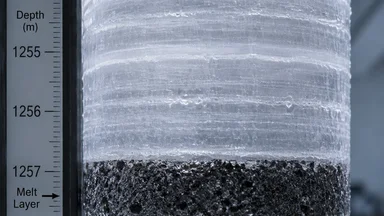
The layer in question came from the GISP2 core, drilled in central Greenland in the 1990s. During annual layer counting, visual stratigraphy revealed a dark, coarse-grained band—a melt feature caused by summer warmth that percolated through the snowpack and refroze. Such layers are rare in central Greenland, where temperatures rarely exceed freezing, but they do occur during exceptional summers. In the original 2010 stack, this particular melt layer was interpreted as a dating artifact—perhaps a dust layer or a crack in the core—and was assigned a different year.
Melt layers are valuable temperature proxies because they integrate summer intensity. A single layer can indicate a season warm enough to produce surface melting, which requires roughly 0°C or higher for sustained periods. In a region where mean summer temperatures hover around -10°C, such events are notable. The GISP2 layer was one of only a handful identified in the Holocene section of the core. Yet because it did not align with a known volcanic horizon or a visible dust event, it was treated as an outlier.
The mistake was not obvious at the time. Ice core chronologies are built by counting annual layers—alternating summer and winter signals in electrical conductivity, dust, and oxygen isotopes. But deep ice becomes brittle and thinned, and annual layers can be ambiguous. The 2010 stack used a different alignment method than later studies, relying on a combination of visual markers and a few volcanic tie points. The melt layer fell in a section where the annual signal was weak, and the counting team assigned it to the wrong year.
It was only when researchers revisited the core in 2019, using a new high-resolution imaging technique, that the layer's true position became clear. The melt layer was not an anomaly; it was a real climate signal that had been shifted by roughly four decades. Correcting it required resequencing the entire stack from that point onward, affecting the temperature reconstruction for a period spanning several centuries.
How Ice-Core Chronologies Are Built
Ice core dating is a painstaking process that combines multiple lines of evidence. The primary method is annual layer counting, which relies on seasonal variations in chemical and physical properties. In Greenland, summer layers typically have higher dust content (from Asian deserts) and lower electrical conductivity, while winter layers show the opposite. Counting these cycles, like tree rings, yields a depth-age relationship. But the method has limits: at depths below about 2,000 meters, the ice is compressed and annual layers can be less than a centimeter thick, making them hard to distinguish.
To anchor the floating chronology, scientists use volcanic tie points—distinctive sulfate peaks from known eruptions, such as the 79 AD Vesuvius eruption or the 1815 Tambora event. These provide absolute dates that can be matched across cores. But volcanic horizons are sparse: only a handful are reliably identified in the Holocene portion of Greenland cores. The rest of the chronology depends on the consistency of the counting, which can drift if a layer is misidentified.
Melt layers are a third, less commonly used marker. They form when surface snow melts and refreezes, creating a dense, coarse-grained layer that stands out in visual stratigraphy. Because melting requires warm conditions, these layers are seasonal indicators, but they are not annual—they only occur in exceptional years. In central Greenland, melt layers are rare enough that each one can serve as a tie point, but only if it is correctly identified and dated. The GISP2 core, for example, contains fewer than 20 melt layers in its Holocene section.
The challenge is that melt layers can be confused with other features, such as dust bands or ice lenses formed by compression. Automated counting algorithms reduce human bias, but they still rely on training data that may not capture rare events. The 2010 stack used a semi-automated method that prioritized volcanic horizons and annual cycles, effectively deprioritizing melt layers. This was a reasonable choice at the time, but it meant that a single misaligned layer could propagate through the entire stack.
Resequencing with a Single Layer
The correction involved re-aligning the GISP2 melt layer with a corresponding feature in the NGRIP core, drilled about 300 km away. NGRIP's chronology was independently built using a different counting method and had a melt layer at roughly the same depth, but with a different assigned age. Cross-correlation of the two records, using both oxygen isotopes and dust concentrations, showed that the GISP2 layer was offset by 42 years relative to NGRIP. Adjusting it shifted the entire GISP2 chronology from that point forward.
The effect on the temperature stack was not trivial. The original 2010 reconstruction showed a rapid early Holocene warming peak around 11,500 years ago, followed by a sharp decline. The corrected version smoothed this peak, reducing the apparent temperature change by about 0.3°C. The millennial-scale variability that had been attributed to ocean circulation changes was also attenuated. Some of the structure that had been interpreted as climate signals turned out to be artifacts of the misalignment.
Seierstad and colleagues, who published the corrected stack in 2021, ran sensitivity tests to see how much a single layer could affect the result. They found that shifting the melt layer by as little as 20 years produced noticeable changes in the stack's shape. The correction also improved agreement with independent borehole temperature profiles, which measure the residual heat from past surface temperatures. Borehole records are less precise in time but more direct in temperature, and they had consistently shown a smoother early Holocene than the original stack.
The resequencing did not change the overall narrative of Holocene climate—orbital forcing still drove a slow cooling trend after the early Holocene optimum. But it did reduce the amplitude of century-scale fluctuations, suggesting that some of the variability in earlier reconstructions may reflect dating noise rather than real climate shifts. The lesson is that even well-established stacks can be sensitive to single tie points.
What the New Stack Shows
The corrected Greenland temperature stack now shows a more gradual early Holocene warming, with peak temperatures around 10,500 years ago rather than 11,500. The difference is subtle—about 0.3°C in the mean—but it matters for understanding the timing of ice sheet retreat and sea level rise. A smoother warming also implies that the climate system responded more linearly to insolation changes, without abrupt jumps that would require additional feedbacks.
Another notable change is the reduction in millennial-scale variability. The original stack had several oscillations of roughly 0.5°C every 1,000–2,000 years, which some researchers had linked to changes in Atlantic Meridional Overturning Circulation. The corrected stack shows weaker oscillations, suggesting that at least some of that variability was an artifact of dating mismatches between cores. This does not rule out real millennial variability, but it does lower the confidence in its amplitude.
The new stack also agrees better with the GRIP core, which had not been included in the 2010 version. GRIP's chronology was independently built and showed a similar smoothed pattern. The convergence of three cores—GISP2, NGRIP, and GRIP—after the correction adds confidence that the revised stack is closer to the true climate history. However, the agreement is not perfect: there remain offsets of 10–20 years in some sections, likely due to remaining counting errors.
Perhaps the most important result is that the stack's sensitivity to a single layer highlights the importance of methodological transparency. The original authors did not hide their methods—they simply did not anticipate that a melt layer could exert such influence. The correction was possible only because the raw data and layer counts were archived. As more cores are drilled, the community will need to maintain open-access layer databases to allow future corrections.
Why One Layer Changes So Much
The outsized effect of a single melt layer stems from how stacks are built. A stack averages multiple cores to reduce noise, but if the cores are misaligned in time, the averaging smears out signals. In the 2010 stack, the misalignment of GISP2 by roughly 40 years meant that its temperature signal was offset relative to the other cores. When averaged, this offset created an artificial oscillation: the peak in one core was averaged with a trough in another, producing a dip that did not exist in any individual record.
Melt layers are especially influential because they represent extreme summer events. A single warm summer can produce a melt layer, but the temperature reconstruction for that year is based on the entire annual signal. If the melt layer is misdated, the entire year's temperature estimate shifts. Since melt layers are rare, each one carries disproportionate weight in the chronology. In the GISP2 core, the misdated layer affected the alignment of about 200 years of record, because the counting error propagated forward.
The nonlinear response of ice accumulation to temperature also plays a role. In central Greenland, snowfall rates vary with temperature and storm tracks. A warming event can increase accumulation, thickening the annual layer and making it easier to count. But if a melt layer is misidentified, the accumulation rate for that year is misestimated, affecting the depth-age relationship for subsequent years. The correction of the GISP2 layer required re-evaluating the accumulation model for a 500-year interval.
Statistical sensitivity tests by Seierstad et al. showed that the stack's shape changed significantly when the melt layer was shifted by 20–50 years. The effect was largest in the early Holocene, where the temperature gradient was steepest. In later periods, where the climate was more stable, the impact was smaller. This suggests that the vulnerability to tie-point errors is highest in intervals of rapid change—precisely where paleoclimate records are most valuable for understanding climate sensitivity.
Practical Lessons for Paleoclimatology
The GISP2 melt layer episode offers several practical lessons for the ice core community. First, legacy cores should be revisited with new techniques. High-resolution imaging, such as line-scan cameras and micro-CT scanning, can reveal features that were missed in the original visual stratigraphy. Several labs are now systematically scanning archived core sections to build comprehensive melt layer databases. These databases will allow future studies to cross-check chronologies more easily.
Second, automated counting methods reduce human bias but still require validation against rare events. Most algorithms are trained on annual cycles and may misinterpret melt layers as dust or cracks. Researchers developing new algorithms should include melt layers as a distinct class in their training sets. The community is working on this: a 2023 workshop at the University of Copenhagen produced a set of guidelines for identifying melt layers, which are being incorporated into the next generation of counting software.
Third, uncertainty propagation should include the possibility of tie-point shifts. Most ice core chronologies report uncertainty in the depth-age relationship, but they often assume that the tie points are correct. The GISP2 example shows that a single tie point can be off by decades, and that this error can propagate through the entire stack. Future reconstructions should run sensitivity tests that vary tie-point assignments and report the range of possible chronologies.
Finally, the episode underscores the need for open-access layer archives. The correction was possible only because the original layer counts were published. Many older cores, however, have only summary data available. The Ice Core Data Cooperative, launched in 2022, aims to digitize and share raw counts for all major Greenland and Antarctic cores. If successful, it will allow researchers to test the robustness of existing stacks and correct errors before they become entrenched in the literature.
The Takeaway for Temperature Reconstructions
The corrected Greenland stack does not overturn our understanding of Holocene climate, but it does refine it. The early Holocene was still warm, but the warming was smoother and the subsequent cooling more gradual. The amplitude of millennial variability is now less certain, which means that studies linking those oscillations to solar variability or ocean circulation should be revisited with the new chronology. The confidence intervals around the reconstruction remain wide—typically ±0.5°C for individual centuries—so the stack should be used with appropriate hedging.
For researchers using the Greenland stack as a boundary condition for climate models, the correction implies that model-data comparisons may need re-evaluation. Some models that previously failed to reproduce the sharp early Holocene peak may now show better agreement with the smoothed version. Conversely, models that matched the old stack may need to be adjusted. The impact will vary depending on the region and the variable being studied.
The broader lesson is methodological: a single datum can rescale a continental record. This is not a critique of the original authors, who did careful work within the standards of their time. It is a reminder that paleoclimate reconstructions are hypotheses, not facts, and that they improve as methods evolve. The GISP2 melt layer correction is part of a larger trend in the field toward greater transparency and uncertainty quantification—a trend that also appears in other disciplines, such as the impact of a mouse gut microbiome shift on obesity drug trials or a reagent pH buffer skewing a fairness game replication.
Next steps include replicating the correction with other ice cores, such as the NEEM and Renland cores, which have independent chronologies. Preliminary comparisons suggest that the melt layer in GISP2 is not unique—similar features exist in other cores and may have been misaligned. A comprehensive re-analysis of all Greenland Holocene melt layers is underway at the University of Bern, with results expected in late 2025. Until then, the corrected stack stands as the best available, but with the caveat that further refinements are likely.
The corrected stack now serves as a more reliable foundation for testing climate models and understanding the sensitivity of the Greenland ice sheet to past warming. Researchers at the Danish Meteorological Institute are already using the revised chronology to recalibrate accumulation rates, which will improve estimates of past ice sheet mass balance. These applied uses demonstrate that even small chronological corrections can have practical consequences for projections of future sea level rise.