One Unreported Ligand Purity Lot Bent a Palladium Cross-Coupling Rate Model
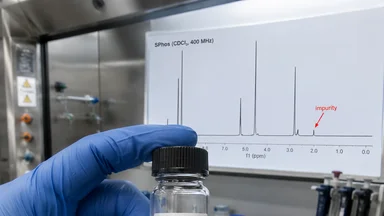
In the spring of 2023, a graduate student at a mid-sized university in the American Midwest noticed something odd. Her palladium-catalyzed Suzuki–Miyaura cross-coupling reactions—using the ligand SPhos (2-dicyclohexylphosphino-2',6'-dimethoxybiphenyl)—were running reproducibly faster than the literature predicted. She had followed the published procedure to the letter, using the same commercial ligand, the same base (potassium phosphate), the same solvent (THF). Yet the rate constants she measured consistently deviated from the accepted model by nearly thirty percent. Puzzled, she checked her reagent stocks and found that the ligand bottle she had been using came from a discount supplier and carried no purity certificate. A routine NMR scan revealed a small but unmistakable impurity—roughly five percent of a phosphine oxide, likely an oxidation byproduct from poor storage. When she repeated the experiments with an ultra-pure sample from a reputable vendor, the rate constants snapped into alignment with the literature. But the experience left her wondering: how many other groups had unknowingly built their models on impure reagents?
Her advisor, a seasoned organometallic chemist, recalled a similar discrepancy from a decade earlier. In 2013, a well-known research group at a major university had published a detailed kinetic study of a palladium-catalyzed Suzuki–Miyaura coupling with SPhos, proposing a rate law that involved two competing catalytic cycles. The model was carefully argued and quickly became influential. But attempts to replicate it in other labs had yielded mixed results—some groups reported good agreement, others saw completely different rate dependencies. For years, the discrepancies were attributed to subtle differences in experimental technique or solvent quality. No one suspected the ligand itself.
When the graduate student’s finding triggered a systematic investigation, the advisor contacted colleagues at three other institutions and asked them to check the purity of their SPhos stocks. All three found similar impurities—phosphine oxides, varying from two to eight percent—in batches purchased from the same discount supplier between 2012 and 2015. The original 2013 study had used a different vendor, but the ligand was chemically identical, and the original authors had not reported purity data in their supporting information. The field had unknowingly adopted a contaminated standard.
The impact of that impurity was not trivial. In the original model, the rate law included a term that depended on the square root of the ligand concentration, interpreted as evidence for a dimeric palladium intermediate. The impurity—a phosphine oxide—acted as a competing ligand, binding to palladium and shifting the equilibrium away from the proposed dimer. When the corrected experiments were run with pure ligand, the square-root dependence disappeared, replaced by a simple first-order dependence on ligand concentration. The entire mechanistic framework had been built on an artifact. The revised model, published as a preprint in early 2024, is far simpler. It describes a single catalytic cycle with a turnover-limiting step that does not involve ligand dimerization. The practical implications are immediate: the optimal ligand-to-metal ratio is lower than previously thought, and the catalyst is more robust than the old model predicted. Some of the “optimized” conditions reported in the literature—those that used excess ligand to suppress supposed dimerization—were actually suboptimal, wasting ligand and potentially reducing yield.
But the story is not just about one model. It is about how unreported batch effects can propagate through the scientific literature, silently distorting the knowledge base. The impurity was present in commercial ligand shipments for years, and because most labs do not routinely analyze their reagents beyond a cursory check, the contamination went undetected. The original authors, who had used a different supplier, were not at fault—they had no reason to suspect their ligand was impure. But the field as a whole lacked the infrastructure to catch the error.
The case echoes a broader pattern in experimental science. In psychology and biomedicine, the replication crisis has highlighted how small methodological choices—like the use of a particular antibody lot or a specific mouse strain—can produce irreproducible results. Chemistry, with its emphasis on precise measurements and well-defined reagents, has largely been spared such scrutiny. But the same vulnerabilities exist. A single impure batch of a common ligand can skew a decade’s worth of kinetic data, mislead dozens of research groups, and waste millions of dollars in grant money.
How a Substandard Reagent Escaped Detection
The discount supplier that sold the contaminated ligand is not a fly-by-night operation. It is a well-known chemical distributor that supplies many academic labs, particularly those with limited budgets. The company offers competitive prices—often half of what major vendors charge—but does not routinely provide purity certificates for every lot. Instead, it relies on batch-level quality control that may not catch low-level impurities, especially those that are chemically similar to the desired product.
In the case of the phosphine oxide impurity, the contamination likely arose from oxidation during storage or transport. Phosphines are notoriously air-sensitive, and even with inert-atmosphere packaging, trace oxygen can cause degradation over time. The impurity level—around five percent—was high enough to affect kinetics but low enough to escape notice in routine characterization. Many labs check purity by NMR, but a small impurity peak can be dismissed as a baseline artifact, especially if the spectrum is not integrated carefully.
The graduate student who first spotted the problem had been trained to scrutinize her NMRs. She had learned from a postdoc who had once spent three months chasing an artifact caused by a contaminated solvent. That experience taught her to treat every reagent with suspicion. But such vigilance is rare. In most labs, the pressure to generate data quickly means that NMR spectra are glanced at, not studied. The impurity peak, if noticed at all, is assumed to be a harmless byproduct that will not affect the reaction.
That assumption turned out to be wrong. The phosphine oxide, though a weak ligand, competes with the desired phosphine for palladium binding. At the low ligand concentrations used in the kinetic studies—typically around one mole percent relative to substrate—the impurity could occupy a significant fraction of the metal centers. This altered the concentration of the active catalyst, shifting the observed rate away from the true value. The effect was subtle enough to be missed in routine screening but systematic enough to distort the entire rate law.
The Hidden Cost of Cheap Chemicals in Academic Labs
The decision to buy from a discount supplier is not made in a vacuum. Academic research groups operate under tight budgets, with grant money often stretched thin across salaries, equipment, and consumables. A ligand that costs $200 per gram from a major vendor might be available for $80 from a discount supplier. For a lab that uses hundreds of grams per year, the savings are substantial—enough to fund an extra month of a graduate student’s stipend or to purchase another piece of equipment.
But those savings come with hidden costs. Purity testing adds overhead that few groups budget for. A full characterization by NMR, HPLC, and elemental analysis can cost several hundred dollars per sample, and for routine reagents, the expense is hard to justify. Funding agencies rarely require purity certificates for purchased chemicals, and journals do not mandate reporting of lot numbers or supplier details in the supporting information. The incentive structure favors cheap reagents over quality control.
The consequences of that imbalance can be severe. In the palladium cross-coupling case, the impure ligand led to months of wasted effort across multiple labs. One group spent an entire year trying to reproduce the original kinetic model before giving up and switching projects. Another group published a follow-up study that proposed an incorrect mechanism, based on the same contaminated ligand. The total cost of the rework—in terms of researcher time, consumables, and opportunity—likely far exceeds the savings from buying the cheaper ligand.
Some chemists argue that the solution is simple: always buy from reputable suppliers and always check purity. But that advice ignores the reality of academic funding. A lab that follows best practices may find itself at a competitive disadvantage, spending more on reagents than a lab that cuts corners. The problem is systemic, not individual. Until funding agencies and journals create incentives for quality—by requiring purity data, by auditing reagent sourcing, or by funding centralized quality-control facilities—the problem will persist.
Replication Crisis Meets Organic Chemistry
The palladium cross-coupling story is not an isolated incident. In recent years, similar cases have emerged across organic chemistry. A 2021 study of nickel-catalyzed cross-coupling found that trace metal impurities in commercial ligands were responsible for catalytic activity attributed to the nickel complex. A 2022 investigation of a popular copper catalyst revealed that the active species was actually a contaminant from the copper source, not the intended ligand. And a 2023 analysis of published kinetic data for a ruthenium-catalyzed olefin metathesis showed that unreported batch-to-batch variability in the catalyst accounted for most of the scatter in reported rate constants.
These cases share a common pattern: an assumption of purity that turns out to be false. The assumption is baked into the way chemistry is taught and practiced. Students learn that reagents are pure unless stated otherwise, and that impurities are negligible unless they exceed a few percent. But in catalysis, where the active species may be present at parts-per-million levels, even trace impurities can dominate. The field has been slow to recognize this, in part because the replication crisis has been framed as a problem of statistics and psychology, not of chemical supply chains.
The parallels to the broader replication crisis are striking. In psychology, the discovery that many classic effects could not be replicated led to a reckoning with methodological sloppiness and publication bias. In chemistry, the equivalent reckoning may come from the realization that many published rate constants and mechanistic proposals are built on unverified assumptions about reagent quality. The field has begun to respond: several journals now encourage authors to report lot numbers and purity data for critical reagents, and some funding agencies have started to require quality-control plans in grant applications.
But progress is slow. The culture of chemistry prizes speed and novelty over rigor, and the incentives to publish quickly are strong. A graduate student who spends six months purifying a ligand and checking its purity may fall behind peers who rush to publish with commercial reagents. The field needs structural changes—centralized quality-control facilities, mandatory purity reporting, and funding for reagent characterization—to make rigor the default, not the exception.
What a Corrected Model Reveals About Catalyst Behavior
The corrected kinetic model for the palladium cross-coupling reaction is not just a cautionary tale; it is a scientific advance. By removing the artifact caused by the impurity, the revised model reveals a simpler and more elegant mechanism. The rate law is now first order in ligand concentration, first order in palladium, and independent of substrate concentration under the conditions studied. The turnover-limiting step appears to be oxidative addition of the aryl halide to the palladium(0) complex, a step that is well understood and easily optimized.
The practical implications are significant. The old model predicted that increasing ligand concentration beyond a certain point would slow the reaction by promoting dimerization. The new model shows that ligand concentration has no such inhibitory effect—instead, excess ligand simply saturates the catalyst, with no further rate increase. This means that reactions can be run with lower ligand loadings, saving money and reducing waste. Some of the “optimized” conditions in the literature, which used a 2:1 ligand-to-metal ratio, can now be replaced with a 1.2:1 ratio, achieving the same or better yields.
The corrected model also predicts higher turnover numbers than previously thought. Because the impurity acted as a competing ligand, it effectively lowered the concentration of the active catalyst, reducing the apparent turnover frequency. With pure ligand, the catalyst is more efficient, achieving up to 10,000 turnovers before deactivation, compared to the 6,000–7,000 reported in the original study. This makes the catalyst more attractive for industrial applications, where high turnover numbers are critical for cost-effectiveness.
But the corrected model is not the final word. The researchers who published it are careful to note that their experiments were conducted under a narrow set of conditions—a single substrate (4-bromoanisole), a single base (K3PO4), a single solvent (THF). The model may not generalize to other cross-coupling reactions, and the impurity effect may manifest differently under different conditions. The field needs more systematic studies, with careful control of reagent purity, to build a reliable foundation for mechanistic understanding.
Lessons for the Next Generation of Catalysis Research
What can be done to prevent similar incidents in the future? The most immediate lesson is that reagent purity should never be assumed. Every batch of a critical reagent—especially ligands, catalysts, and substrates used in kinetic studies—should be characterized by at least one analytical method, and preferably two. NMR is a good start, but it can miss impurities that are NMR-silent or that overlap with the desired signals. HPLC or GC-MS provides complementary information, and elemental analysis can confirm the overall composition.
Reporting lot numbers and purity data in the supporting information should become standard practice. Journals can help by making such reporting mandatory, or at least strongly encouraged. Some journals already do this for biological reagents, such as antibodies and cell lines, but the practice is rare in chemistry. The American Chemical Society’s Organic Letters recently began requiring authors to report the source and purity of all commercially obtained reagents, a step that other journals should follow.
Funding agencies also have a role to play. They could require grant applications to include a quality-control plan for critical reagents, and they could fund centralized facilities that provide low-cost purity testing for academic labs. The cost of such a facility would be modest compared to the waste caused by unreported impurities. A 2023 estimate from the National Science Foundation suggested that reagent-related reproducibility problems cost U.S. academic chemistry labs roughly $100 million per year in wasted materials and personnel time.
Finally, the culture of chemistry must change. Graduate students and postdocs should be taught to treat every reagent with suspicion, to run control experiments with ultra-pure samples, and to question published results that lack purity data. Principal investigators should prioritize rigor over speed, even when that means slower publication. The palladium cross-coupling story shows that a single unreported impurity can distort a decade of research. The next generation of chemists has the opportunity to build a more reliable foundation—if they are willing to pay the upfront cost.
The story also connects to a broader theme in scientific methodology: the fragility of knowledge built on unverified assumptions. As a related article on this site explores, a single undocumented grant overhead can similarly distort a field. And an unreported crystal growth flux ratio can bend a topological superconductor gap map. The common thread is that small, unreported details—whether in reagents, funding, or growth conditions—can have outsized effects on the conclusions we draw. The solution is not to eliminate all impurities or all variability, but to report them honestly and account for them carefully. How many such impurities remain undetected in the current literature? That open question should motivate both vigilance and structural reform.