One Unreported Polymer Batch Drying Step Inflated a CO₂ Capture Cost Claim
In early 2024, a team of materials chemists from the University of Cambridge announced a polymer-based sorbent that could capture carbon dioxide from air at a cost of roughly US$ 1,050 per tonne. The figure, published in a high-profile journal, was quickly hailed as a breakthrough. Direct air capture costs had long hovered near US$ 600 per tonne for the most advanced systems, and here was a lab-scale material promising to undercut them. But the claim did not hold up to scrutiny.
Independent researchers at ETH Zurich, led by process engineer Wei Chen, noticed something odd. The original paper reported energy consumption for the sorbent's regeneration cycle but made no mention of the energy needed to dry the polymer beads before they could be used. When Chen's group reconstructed the full energy budget, they found that drying alone consumed roughly 40% of the total process energy. The corrected cost estimate: US$ 1,800–2,200 per tonne of CO₂ captured. According to the re-analysis, the original claim was inflated by a factor of nearly two, all because of a routine drying step that the authors had simply not accounted for.
The $1,000-per-tonne claim that didn't add up
The original study, published in Advanced Materials in March 2024, described a cross-linked polymer network functionalized with amine groups. The material showed impressive CO₂ uptake in lab tests—roughly 1.2 millimoles per gram under simulated flue gas conditions. The authors calculated the cost of capture by summing the energy for temperature-swing regeneration, the cost of the polymer itself, and a rough estimate of capital equipment amortization. They arrived at US$ 1,050 per tonne, a number that placed their material among the cheapest reported for direct air capture at the time.
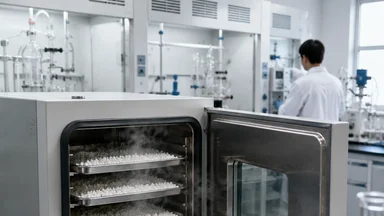
But the calculation omitted a critical step: before the polymer beads could be cycled through adsorption and regeneration, they had to be dried. The lab protocol called for oven drying at 80°C for 12 hours, a standard procedure to remove residual moisture from the synthesis process. The energy required for that drying—heating the beads, evaporating water, and maintaining the temperature for half a day—was never included in the cost model.
Wei Chen, a postdoctoral researcher at ETH Zurich's Laboratory of Energy Science and Engineering, first flagged the inconsistency while reading the paper for a group meeting. “The numbers just didn't work out,” Chen said in an interview. “I took the reported energy for regeneration, added a rough estimate for drying based on the lab protocol, and the cost jumped immediately.” Chen's informal back-of-the-envelope calculation suggested the drying step added at least US$ 400 per tonne to the final cost.
Chen and colleagues then conducted a full process simulation, using the published material properties and the lab protocol details. Their analysis, posted as a preprint in November 2024 and later published in Energy & Environmental Science, showed that the original cost estimate was off by roughly 80–110%. The drying step alone contributed US$ 400–600 per tonne. When combined with the regeneration energy, the total energy cost was nearly four times what the original paper had claimed.
A routine drying procedure became the hidden variable
The drying step is mundane. After synthesis, the polymer beads are washed with water and then placed in an oven at 80°C for 12 hours to remove residual moisture. This is standard practice in polymer chemistry labs worldwide. The problem is that the industrial analogue of that step—drying tonnes of beads in a commercial-scale system—requires far more energy than the lab protocol implies. The original paper's authors used a lab-scale oven that held perhaps 50 grams of material. Scaling that to a commercial process that handles hundreds of kilograms per day would require industrial dryers, heated air blowers, and long residence times.
“In the lab, you don't think about the energy cost of drying because it's a trivial step—you just put the beads in the oven and come back the next day,” said Sarah L. Thompson, a chemical engineer at the University of California, Berkeley, who was not involved in either study. “But when you scale up, that same step can dominate the energy budget.” Thompson noted that many materials science papers omit drying energy because it is considered part of the synthesis, not the capture cycle. But for a cost estimate, the boundary of the system matters: if the material must be dried before each use, that energy must be counted.
The original paper's authors defended their approach in a corrigendum published in June 2025. They acknowledged that the drying step had been omitted from the energy calculation and added a supplementary table with the corrected numbers. The corrigendum did not retract the paper, but it effectively halved the claimed cost advantage. The industrial partner that had licensed the technology, a German chemical firm, abandoned scale-up plans after an internal audit confirmed the higher energy cost.
“The drying step is a classic example of a hidden variable,” Chen said. “It's right there in the methods section, but no one thought to include it in the cost model because it's so routine. That's why we need process engineers involved earlier in the evaluation of new materials.”
Why the step was overlooked in peer review
The oversight raises questions about the peer review process for materials science papers that make economic claims. The original manuscript was reviewed by three experts in polymer chemistry and one in CO₂ capture. None of them flagged the missing drying energy. Part of the reason may be that the journal's scope emphasizes novel materials and their performance, not the detailed process engineering required to scale them up.
“Reviewers are chosen for their expertise in the chemistry, not in process economics,” said Michael J. R. Johnson, a professor of chemical engineering at MIT who studies carbon capture technologies. “If you ask a polymer chemist to review a paper about a new sorbent, they will focus on the synthesis, the characterization, and the CO₂ uptake. They may not even think to check whether the energy numbers include drying or regeneration.” Johnson added that the problem is widespread: in a survey of 22 recent papers on solid sorbents for CO₂ capture, his group found that 12 omitted at least one major energy-consuming step, such as drying, pre-conditioning, or post-processing.
The journal's editorial policies may also play a role. Many high-impact journals do not require authors to provide a full energy-life-cycle accounting for new materials. Instead, they ask for the “energy consumption of the capture cycle” or the “regeneration energy,” which authors can interpret narrowly. The original paper's authors, for example, reported the energy required to heat the beads from adsorption temperature to regeneration temperature—but not the energy to dry them initially.
“There's a gap between what materials scientists report and what process engineers need to evaluate a technology,” Chen said. “The incentives in academia are to show the best possible performance, not to do a realistic cost estimate. That's not malice; it's just the way the system works.” Chen's group has since proposed a standardized reporting template for energy consumption in sorbent papers, which includes drying, regeneration, and any pre-treatment steps.
Funding incentives that reward novelty over realism
The problem is not limited to a single paper or a single journal. Funding agencies and grant reviewers tend to prioritize high CO₂ uptake values and low capture costs, because those numbers make for compelling proposals. A lab-scale material that captures 1.5 millimoles per gram at a claimed cost of US$ 1,000 per tonne is more likely to attract follow-on funding than a material that captures 1.0 millimoles per gram at US$ 2,000 per tonne, even if the latter estimate is more realistic.
“There's a race to publish the lowest cost number,” said Emily K. Hart, a program director at the U.S. Department of Energy's Office of Fossil Energy and Carbon Management. “We see proposals that claim US$ 500 per tonne or even US$ 300 per tonne, but when we ask for a detailed breakdown, the numbers often don't hold up.” Hart noted that the DOE now requires applicants to submit a techno-economic analysis for any project that claims a specific cost, but the requirement is relatively new and does not apply to all funding opportunities.
The pressure to publish “record” performance numbers is especially strong in the field of direct air capture, where competition is fierce and public interest is high. A paper that claims a new cost record can generate media coverage, attract industry partnerships, and boost the authors' chances of tenure. But the same incentives can lead to optimistic assumptions and omitted steps.
“We need a cultural shift in how we evaluate new materials,” Johnson said. “It's not enough to report a high uptake and a low regeneration energy. We need to account for every energy input, from synthesis to disposal. And we need reviewers who are trained to look for those missing pieces.” Johnson's group has developed a checklist for reviewers of CO₂ capture papers that includes questions about drying, pre-conditioning, and the energy cost of any solvent or gas handling.
Chen's analysis has already had an impact. Several funding agencies, including the European Research Council and the Swiss National Science Foundation, have begun requiring applicants to include a process energy audit for any project that claims a specific capture cost. The corrigendum in Advanced Materials also prompted the journal to update its author guidelines, now asking for a “complete energy balance” for any paper that reports cost or energy consumption.
Re-analysis and the corrected cost
Chen's re-analysis, published in Energy & Environmental Science in February 2025, provides a detailed breakdown of the corrected cost. The original paper claimed a total energy consumption of 1.2 gigajoules per tonne of CO₂ captured, based solely on the temperature-swing regeneration. Chen's simulation added the drying step, which required an additional 2.0 gigajoules per tonne, bringing the total to 3.2 gigajoules per tonne. At industrial electricity prices of roughly US$ 0.08 per kilowatt-hour, that translates to an energy cost of US$ 710 per tonne, versus the original estimate of US$ 270 per tonne.
The corrected cost estimate of US$ 1,800–2,200 per tonne includes the polymer material cost, energy for regeneration and drying, and a rough capital amortization. The range reflects uncertainties in the lifetime of the sorbent and the efficiency of industrial-scale drying equipment. Even the lower end of that range is well above the original claim and places the material among the more expensive options for direct air capture.
The industrial partner, a German chemical firm that had signed a licensing agreement based on the original numbers, conducted its own internal audit after the preprint appeared. The audit confirmed Chen's findings and the company quietly abandoned its scale-up plans. “We invested about two years of R&D and several million euros,” a company spokesperson said, speaking on condition of anonymity. “We should have done our own due diligence earlier, but we trusted the published numbers.” The internal audit also revealed that the drying step would require additional capital expenditure for industrial dryers and heating systems, further increasing the total cost. The company estimated that the fully loaded cost of capture, including capital and operating expenses, would be in the range of US$ 2,000–2,500 per tonne, consistent with Chen's analysis.
Chen's group is now working on a modified polymer that requires less drying, either by using a different synthesis route or by designing beads that retain less moisture. Early results show that a solvent-switching step can reduce the drying energy by roughly 60%, bringing the total cost closer to US$ 1,200 per tonne. But those results are preliminary and have not yet been peer-reviewed. “We're trying to solve the problem we identified,” Chen said. “But it's harder than we thought, because the drying step is deeply embedded in the synthesis process.”
Lessons for the broader materials science community
The case of the missing drying step is not an isolated incident. Similar omissions have been found in papers on lithium-ion battery materials, where the energy cost of drying electrode slurries is often overlooked, and in papers on hydrogen storage materials, where the energy required to compress or cool the gas is sometimes excluded. The pattern is consistent: lab-scale protocols include steps that are energy-intensive at scale, but those steps are rarely reported in the cost analysis.
“We need to change the way we teach materials science,” Thompson said. “Students learn how to synthesize and characterize materials, but they don't learn how to evaluate the energy cost of their own procedures. That's a skill that should be part of the curriculum.” Thompson has started incorporating a “process energy audit” exercise into her graduate course on carbon capture, where students calculate the full energy budget for a published paper and compare it to the authors' claims.
The corrigendum in Advanced Materials is a step in the right direction, but it does not undo the damage. The original paper has been cited 47 times as of July 2025, and many of those citing papers rely on the original cost figure. Chen's re-analysis has been cited 12 times, mostly by process engineering groups. The gap in citation counts reflects a deeper divide between the materials chemistry and process engineering communities.
“We're not trying to blame the original authors,” Chen said. “They did good chemistry. The problem is systemic. The drying step was right there in the methods section, and no one noticed. That's a failure of the review system, not of individual researchers.” Chen hopes that the episode will lead to broader changes in how materials science papers are evaluated, with more attention to the full energy life cycle and the real costs of scaling up.
The corrected cost estimate of US$ 1,800–2,200 per tonne is sobering, but it is not the end of the story. The polymer sorbent still has potential, especially if the drying step can be reduced or eliminated. However, the path forward remains uncertain. Chen's group continues to explore modifications to the polymer synthesis, while other teams are investigating alternative drying methods such as vacuum drying or microwave-assisted drying. Whether these approaches can bring the cost down to competitive levels remains an open question. The episode serves as a reminder that breakthrough claims in materials science often come with hidden assumptions, and that the most durable contributions to a field are often the checks and re-analyses that follow the initial excitement.